


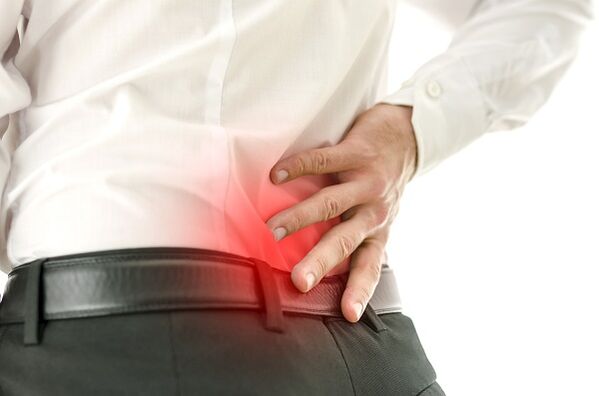
Pain in the lumbar region can often bother a person; they are caused by various circumstances.The causes of back pain in the lumbar region are associated with vertebrogenic diseases or pathological changes affecting internal organs.Periodically, the lower back hurts due to systemic pathologies.The location of the pain syndrome is different: in many patients the pain may be on the right or left side, at the bottom or at the top of the lumbar segment.
Often such pain in the spine is a sign of pregnancy in its initial or final stages.In case of acute pain syndrome, hyperthermia is observed, the patient requires urgent treatment.First, you need to contact a therapist, he will assess the patient’s condition and recommend other specialists for consultation and treatment.To find out why a person is bothered by pain in the spine, various diagnostic measures are prescribed (MRI, CT, ultrasound).
Characteristics of the syndrome
Lumbar pain occurs:
- Strong.
- Spicy.
- Aching.
- Chronic.
- Moved.
Also, the pain can be mild, painful, paroxysmal, pulsating.The causes of severe pain are caused by osteochondrosis.A person’s lower back always hurts: when walking, sitting, lifting heavy objects, coughing, sneezing.This pain sometimes radiates to the legs, and the lower extremities may also become numb, causing paresthesia.If a patient has radiculitis of the lumbar and sacral vertebral segment, then not only the lower back will hurt greatly.
Painful sensations will cover the buttock, thighs, pelvis, and legs.They will intensify when walking, coughing, or changing body position.If you experience similar symptoms of lower back pain, you should contact a neurologist.To ensure that the lumbar area is in a physiological position, sleeping on a hard mattress is recommended.
Acute pain is observed:
- when stretching muscle tissue;
- staying in a non-physiological position for a long time;
- lifting heavy objects;
- injury;
- sharp movements;
- hypothermia.
At home, you can treat with gels or ointments that relieve inflammation and pain.They will improve microcirculation and eliminate swelling.If the pain does not go away within 2-3 days, then medical attention is needed.When your back hurts badly in the lumbar region on the first day, you need to be on bed rest.
Aching pain is caused by myositis of the lumbar zone.The patient's movements are constrained, he feels pain with any movement.To get rid of pain, you first need to stand under a warm shower, then dress warmly.Any physical activity is unacceptable.Pain syndrome can be treated with warming ointments.

Chronic pain develops due to spondylosis deformans.A patient with this pathology is bothered by pain in the lumbar area, sensitivity may be lost, and lethargy will occur in the legs.Chronic pain is also caused by ankylosing spondylitis with impaired metabolism and malignant neoplasms.In this case, folk remedies will not work to treat the lower back.If your lower back hurts very much for 3 days, then medical help is needed.
With displaced pain, the patient feels discomfort in the lumbar area, he thinks that the cause of the symptoms is pathologies of the spine.But such pain is caused by pathological processes in the internal organs of the pelvic area, oncology, pathologies of the gastrointestinal tract, or malfunction of the kidney.
Reasons
The causes of lower back pain are interrelated with the formation of sciatica and lumbago.These pathological processes are the result of osteochondrosis changes in the lower back, protrusions, and herniated discs located between the vertebrae.If several vertebrae have shifted, then the spine will also hurt.If the lower back hurts constantly in men and women, then the nerve endings of the spine are irritated, the muscles and ligaments are swollen.
In a woman, pain in the lumbar area is caused by cystitis, pyelonephritis, urolithiasis, or her uterine appendages are inflamed.In men, lower back pain may occur due to prostate problems.Acute pain is caused by various pathological processes:
- Osteochondrosis.
- Protrusion, intervertebral hernia.
- Spondyloarthritis.
- Spinal epiduritis.
- Spinal fractures.
- Pathological changes in the hip joints.
- Sciatica, lumbago.
- Impaired spinal blood flow in the acute stage.
- Acute pyelonephritis.
- Acute appendicitis.
- Intestinal obstruction.
Chronic pain is caused by pathologies:
- Bekhterev's disease.
- Spondylosis deformans.
- Urolithiasis.
- Osteomyelitis.
- Scoliosis.
- Osteoporotic, osteomalacia changes.
- Oncological processes in the spinal cord, retroperitoneal zone, spine.
- Spinal infections (brucellosis, tuberculosis, epidural abscess).
- Pathologies of non-infectious origin (with Reiter's syndrome, rheumatoid arthritis, ankylosing spondylitis).
- Renal oncology.

Radiating pain sensations are caused by:
- Gastrointestinal pathologies.
- Atherosclerosis.
- Pathologies in the pelvis.
- Gynecological pathologies (inflammation of the uterine appendages, uterine cancer, endometriosis, sexually transmitted diseases).
- Male diseases (prostate cancer, prostatitis).
- Renal colic, kidney stones.
- Intestinal diseases (ulcerative colitis, inflamed diverticulum, nonspecific intestinal neoplasms).
- Dissecting aortic aneurysm.
Only a doctor can diagnose a patient’s condition.
Pain above the lumbar region
If a person has pain on both sides above the back, then he probably suffers from kidney failure, hepatitis, or taking highly toxic medications.Therefore, liver function is impaired.The patient will experience bloating, nausea, and a burning sensation in the right hypochondrium.Above the lumbar area it may hurt due to acute renal pathologies.Most likely, the person suffers from polycystic disease, chronic pyelonephritis, or there are tumors.
If during acute pyelonephritis swelling is observed or the ureter is blocked, then the pain is intense and has a dull, aching character.These pains, radiating to the umbilical area and lower abdomen, are long-lasting and constant.Another discomfort will appear from the right or left hypochondrium.
Pain below the lumbar region
If there is pain and aching in the lumbar segment, then the person probably has problems with the spine.A woman experiences such symptoms before her period.Then the back and abdominal area will be painful.Also, such symptoms will appear with adnexitis, oophoritis, salpingo-oophoritis.If the lower abdomen is painful, then the intestines are disrupted or the appendix is inflamed.In this case, the pain will not subside even in a lying position.

A man may experience severe pain or ache in the lower back due to pathologies of the prostate gland or damage to the bladder.
Discomfort on the right and left sides
If the right and left sides are painful at the same time, then the person may be sick with pyelonephritis, hepatitis, or cholecystitis.Lumbar pain will appear with inflamed uterine appendages or prostatitis.If the posterior segment of the subcostal area hurts, then the person probably suffers from pleurisy, pneumonia.If pain radiates and is felt above or below the lumbar segment on the right, then the patient may suffer from atypical appendicitis or intestinal obstruction.
The causes of pain in the lumbar region on both sides are associated with vertebrogenic pathologies and diseases developing in the internal organs.
Treatment
Treatment of lower back pain should begin by contacting a doctor, who will prescribe diagnostic measures and establish a diagnosis.Untested methods of therapy will only do harm, blur the picture of the pathology, which will move from the acute stage to the chronic stage, and other complications will arise.Once the diagnosis is established, medications are used.
Treated:
- Non-steroidal drugs that relieve inflammation.
- Chondroprotectors.They will protect cartilage tissue from destruction and restore it.
- Muscle relaxants.They will eliminate pain and relax spasmodic muscles.
- Glucocorticosteroids.They eliminate inflammation and relieve severe pain.
- B vitamins (B1, IN12, IN6).Used with non-steroidal drugs.
They are also treated with creams, gels, and ointments.When used externally, these remedies will reduce discomfort, relax muscles, and improve microcirculation.Warming ointments are used, the basis of which is bee or snake venom, and red pepper.
Ointments with chondroprotective effects are also indicated.The use of a special patch is indicated.One plate lasts 12 hours.The invisible strip lasts all day.Magnetized plates are impregnated with non-steroidal agents.If the patient suffers from myositis, radiculitis, osteochondrosis, spondylolisthesis, or the person is injured, then they are treated with non-steroidal anti-inflammatory drugs.
You can treat with simple painkillers.Paravertebral blockades are performed by a doctor using painkillers.
Physiotherapy
Electrophoresis with the introduction of medications effectively treats pain; special muds, ozokerite with paraffin, baths with turpentine, amplipulse therapy are also used, and muscles are stimulated with electric current.The doctor selects a complex of exercise therapy individually after the exacerbation has been eliminated.Thanks to gymnastics, muscle tissue will be strengthened and blood circulation will improve.According to indications, a corset is used to reduce the load on the spine in case of vertebrogenic pathologies.
Exercising on the exercise machine has a positive effect on the back muscles.You cannot jump, make sharp turns, swing your legs, run, or do strength exercises.Massage procedures, which are used after the exacerbation has been eliminated, have a positive effect on the lower back.The muscles will warm up, spasms will be eliminated, blood circulation will improve, and the person’s well-being will normalize.
Approximate set of exercises
Starting position: the patient should lie down.In turn, each leg is raised no higher than 10–15 cm. You need to hold the raised leg in weight for 10 or 15 seconds.Perform 10 or 15 times for each lower limb.In a lying position, bend your legs at the knee joints at an angle of 90 to 100º.After this, the bent lower limbs are tilted to the right and left until it stops.Perform no more than 15 times.
You need to lean right and left at a slow pace with your back straight.Perform bends 20 times in one direction and the other.You need to get on all fours.They swing their right arm and left leg at the same time, then their left arm and right leg.Perform 10 to 15 times.Get on all fours so that your stomach is facing up.Arch your back upward and hold this position for as long as possible.Perform 5 times.
Traditional methods
Traditional methods are used in addition to the main treatment; before using them, consult your doctor.In case of exacerbation, warming compresses are not used, otherwise pathological changes will be activated and the infectious process will progress.Compresses made from burdock leaves are applied to the lumbar region.The leaves can be used fresh or steamed.Use an ointment with a warming effect.It consists of petroleum jelly, rosemary oil, lavender, fir, orange, eucalyptus.

Compresses with vegetable oil and garlic or mustard powder are indicated.
They drink chamomile, thyme, and St. John's wort infusion.Various infusions with decoctions of mint, chamomile, violet, knotweed, calendula, and burdock root are also used.Fruits, flowers, and plant roots are used.To activate metabolic processes and reduce inflammation, it is recommended to take poplar buds, wheatgrass rhizomes, valerian, immortelle, knotweed, dandelion, and white willow bark.
They use ointments based on pork fat and plantain, pine buds, anise, burdock root, birch and sage leaves.It is important to remember that only the doctor prescribes the treatment plan.Self-medication will lead to negative consequences.If pain occurs that does not go away for more than 2-3 days, you should urgently seek medical help.Then the pathological process will not become chronic, and the prognosis for the patient will be favorable.